E‑Commerce Returns: Checkout Best Practices That Reduce Refunds in 2026
Most retailers make the mistake of treating returns as a warehouse problem. In 2026, the operational reality is different: returns are not won in logistics; they are won or lost at checkout. An ambiguous payment process is the perfect incubator for mismatched expectations and promises the system cannot keep.
“Most returns don’t happen after delivery — they happen at checkout.”
Checkout Determines 40% of All Returns in 2026
Buyer’s remorse and technical discrepancies stem from a lack of clarity. From a micro-data perspective, Customer Acquisition Cost (CAC) is irrelevant if margins are diluted by reverse logistics. If the checkout process allows for incomplete information, the sale automatically transforms into future debt.
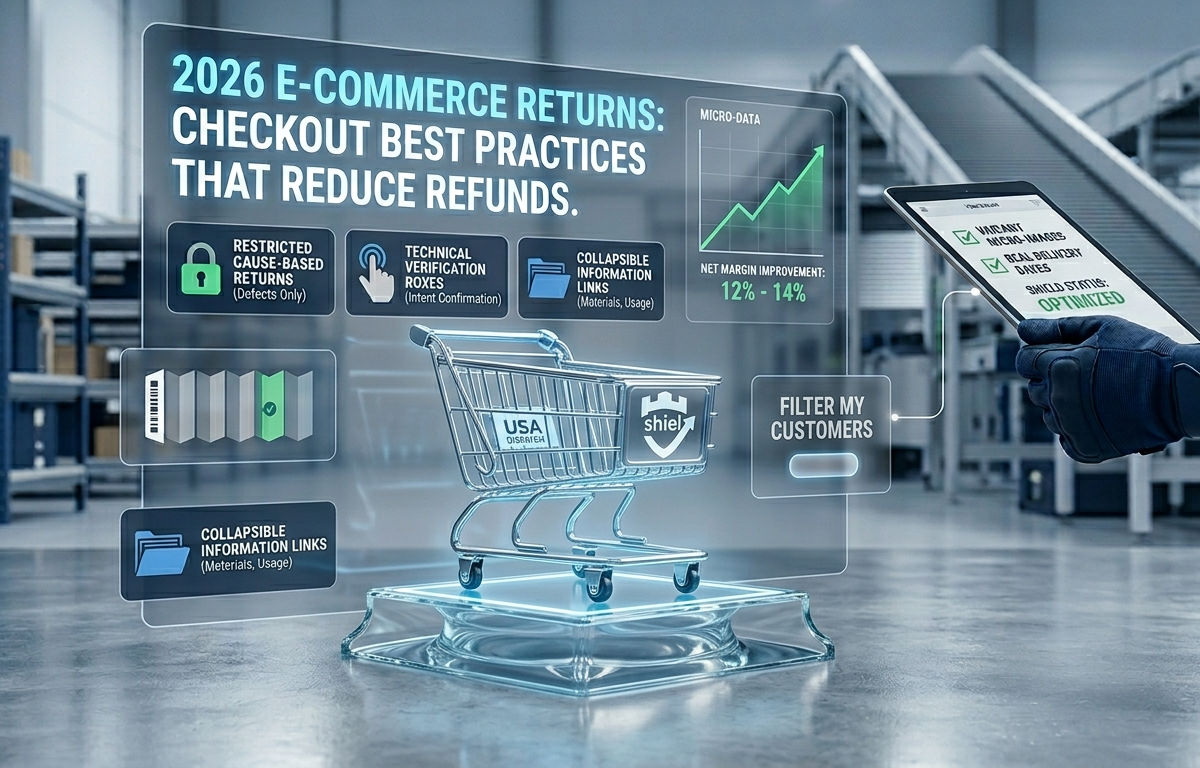
Technical Implementation: The 5 Best Practices for 2026
1. Show Real Delivery Dates, Not Ranges
Vague delivery windows (e.g., “3-7 days”) trigger returns driven by impatience.
- Impact: Aligns customer expectations with the actual capacity of your nodal network.
2. Display Total Cost (Shipping + Taxes) Before Payment
Late-stage “sticker shock” puts customers on the defensive.
- Impact: Drastically reduces immediate remorse and chargebacks.
3. Add Micro‑Images of Variants in the Checkout
Seeing the exact icon (color, size, model) in the order summary serves as the final visual validation.
- Impact: Blocks variant errors—a top 3 cause of returns—before picking begins.
4. Technical Verification Boxes (Intent Confirmation)
Force the customer out of “autopilot mode” using mandatory, single-click checkboxes:
- Fashion: “I confirm this is my usual size.” (Reduces size-related returns by 8% to 14%).
- Tech/Specific Use: “I have verified that this product is only compatible with [X]” or “I understand that lack of technical knowledge is not a valid reason for return.”
5. Restricted Cause-Based Returns
The policy must be a statement of absolute clarity that deactivates returns based on subjective motives or user lack of skill.
- The Thesis: If the product works and meets specifications, the sale is final. “Personal” returns are not feasible.
- Example: “Returns only for manufacturing defects. Personal preference is not a valid cause for refund.”
The Commitment Filter: “Customer Cleaning”
From a micro-analysis standpoint, a “Non-Sale” is a financial success compared to a return. The checkout must act as a quality filter: if a customer is unwilling to commit to a fair agreement for both parties, they are not worth having as a customer. It is preferable to lose the conversion than to inherit an operational problem.
Operational Shielding Table: The Micro-Impact of the Sale
| Scenario | E-commerce Action | Margin Result |
| Customer rejects terms | Non-Sale (Filter) | $0 Loss (Bunker Success) |
| User lacks technical skill | Video Support / Guide | Consolidated Sale |
| Change of mind | Denial (Closed Policy) | Zero Logistics Expense |
| Manufacturing Defect | Replacement via Nodal Network | Controlled Expense |
Collapsible Information Links at Checkout
To ensure the buyer “knows how to behave,” the checkout includes collapsible links (accordion style) with critical details on materials, usage, and specifications, preventing the user from navigating back to the catalog and losing focus on the commitment.
Final Insight — Returns Are Won or Lost Before the Sale
In 2026, profitability does not come from selling to everyone, but from selling to the right people. Transparency is not a customer service luxury; it is a financial engineering tool.
“A non-sale is a profit. A bad sale is a debt.”
[NEXT POST]
In the next installment: Catalog Strategies. How to mitigate returns starting from the product page design—the other great unknown.
⭐ Strategic FAQs
FAQ 1: How does “Customer Cleaning” affect my pixel and marketing algorithms? By blocking low‑quality buyers at checkout, you prevent Meta/Google from training on “serial returner” behavior. This forces the algorithm to optimize for high‑intent profiles only, lowering long‑term CAC and increasing the density of profitable customers.
FAQ 2: What is the “Micro-Threshold” for allowing a return vs. denying it? If the cost of reverse logistics plus the item’s depreciation exceeds 40% of the product’s value, the sale must be protected at the checkout level with a “Final Sale” verification box. Below this threshold, you can afford more flexibility; above it, your bunker must be impenetrable.
FAQ 3: Can I implement these checkboxes for only specific “High-Risk” segments? Yes. Advanced checkout engineering allows you to trigger technical verification boxes only for products with a historical return rate higher than 15%. This keeps the flow fast for “safe” items while deploying the operational shield only where the margin is actually at risk.
FAQ 4: What is the legal standing of a “Defect-Only” return policy in the US? In most US jurisdictions, as long as the policy is conspicuously displayed and the customer provides an explicit affirmative action (checking a box), a “Sales are Final unless Defective” policy is enforceable. This shift moves the business from a “convenience model” to a “professional equipment model.”