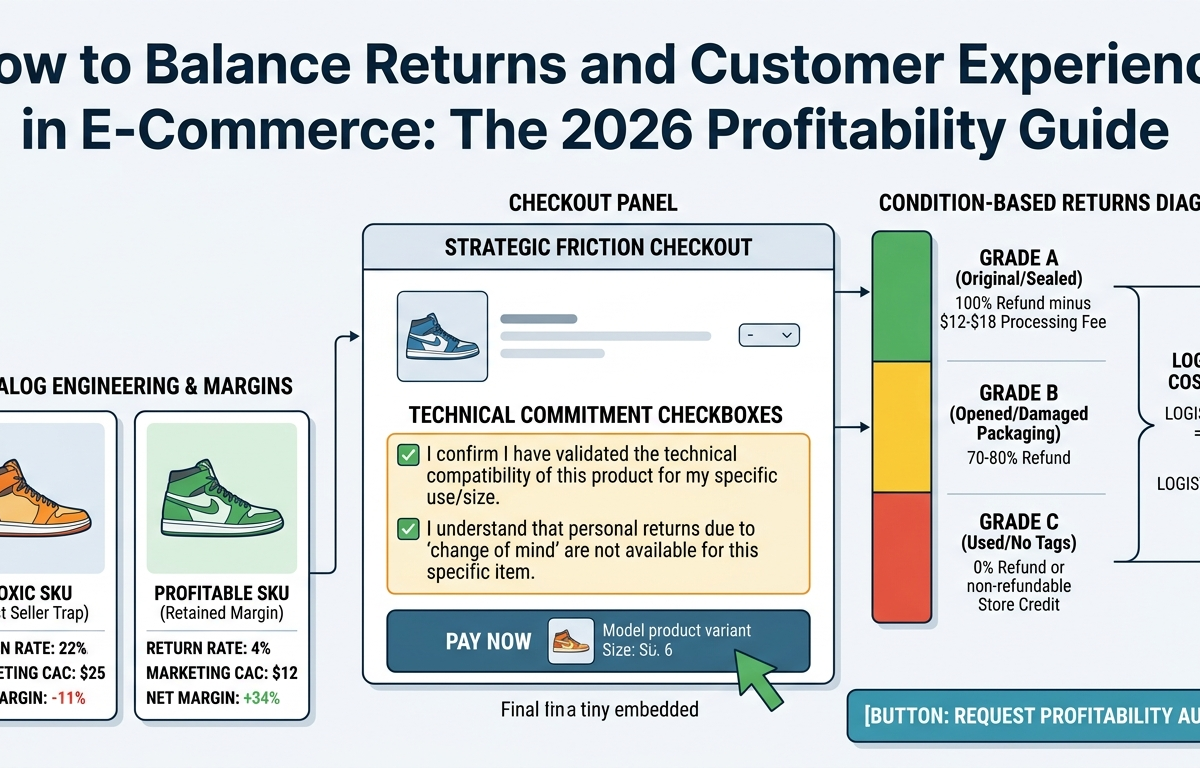
How to Balance Returns and Customer Experience in E‑Commerce: The 2026 Profitability Guide
To maintain a stable and profitable e-commerce business in 2026, you must implement Strategic Friction in the checkout, apply Restricted Return Fees for non-defective items, and perform Catalog Engineering based on net margins rather than gross sales. This approach ensures you filter out high-cost customers and protect your long-term EBITDA without compromising the experience of high-value buyers.
H2: How to Calculate the Real Cost of E-Commerce Returns to Protect Your Net Margin
In 2026, profitability is measured by Retained Net Margin. To protect it, you must stop auditing gross revenue and start applying the Reverse Logistics Cost (LR-Cost) calculation. A return is not a canceled sale; it is an operational expense that drains your cash flow.
The Real Cost Formula:
To understand the actual impact on your financial bunker, apply this calculation to every incident:
Total Return Cost = [Si + Sr] + Ph + Ia + Dv + Mc
- [Si + Sr] (Shipping In/Out): The total cost of freight (original shipping + return shipping).
- Ph (Processing): Man-hours required for receiving, opening, and verifying the item’s condition.
- Ia (Administrative): Non-refundable payment gateway fees and administrative refund management.
- Dv (Depreciation): Loss of asset value due to packaging damage, wear, or the need to sell as “refurbished.”
- Mc (Marketing CAC): The Customer Acquisition Cost (Ad spend) burned on a sale that failed to consolidate.
Outcome: If the sum exceeds 40% of the unit’s gross margin, the sale was a financial mistake. In this scenario, a “Non-Sale” is your success KPI.
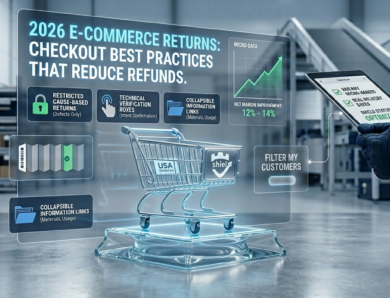
Implementing Strategic Friction at Checkout: Using Technical Checkboxes to Filter High-Cost Customers
Checkout is not just a payment gateway; it is a customer quality filter. To balance user experience with profitability, we implement “positive friction” to ensure buyer commitment before activating logistics.
1. Mandatory Technical Commitment Boxes
Force the customer out of “impulse buy” mode with one-click mandatory validation checkboxes:
- Usage Confirmation: “I confirm that I have validated the technical compatibility of this product for my specific use/size.”
- Policy Acceptance: “I understand that personal returns due to ‘change of mind’ are not available for this specific item.”
*This friction point is a strategic gold mine. By normalizing this concept, we shift the customer’s mindset from impulsive buying to product commitment. Instead of seeing this as a barrier, we transform it into a new sales channel. If a customer needs help, we pivot the return intent toward high-value alternatives such as direct links to expert setup videos, downloadable maintenance guides that act as lead magnets, or exclusive cleaning kits and accessories. We turn a potential logistics loss into an opportunity for cross-selling and long-term loyalty, ensuring that every interaction after the checkout is a new path to increased LTV.
2. Double-Layer Visual Validation
Implement a micro-image of the exact variant (color, model, technical spec) embedded directly into the final “Pay Now” button. This last-second visual validation reduces human error by 18%.
3. Customer Quality Filtering (Customer Cleaning)
Use data analysis to identify profiles with historical return rates higher than 25%. For these users, the checkout should automatically:
- Deactivate free shipping incentives.
- Apply a preventive Processing Fee.
- Limit payment options to those with the lowest refund reversal commissions.
The Economics of Return Fees: How to Apply Processing Charges and Condition-Based Refund Policies
In 2026, “free returns” have shifted from a customer experience standard to a capital drain. Balance is restored through Strategic Conditionality: if the customer breaks the purchase contract for reasons unrelated to the product, the business should not bear the operational cost.
1. Implementation of Strategic Processing Fees
Do not call it a penalty; call it an Asset Processing Cost. Applying a flat fee (e.g., $12 – $18) for “change of mind” returns covers the Ph (Handling) and Ia (Administrative) expenses detailed in our formula.
- Impact: Reduces impulsive returns by 22% without affecting customers who truly receive a defective product.
2. Condition-Based Refund Tiers
Refunds should not be binary (0 or 100). Implement a system based on the asset’s condition post-inspection:
- Grade A (Original/Sealed): 100% refund minus the Processing Fee.
- Grade B (Opened/Damaged Packaging): 70-80% refund (compensating for Dv – Depreciation).
- Grade C (Used/No Tags): 0% refund or non-refundable store credit only.
3. The “Defects-Only” Policy for Technical SKUs
For high-complexity products or specific tools (Bunker Items), the policy is closed:
- Protocol: Returns are only accepted for certified manufacturing defects.
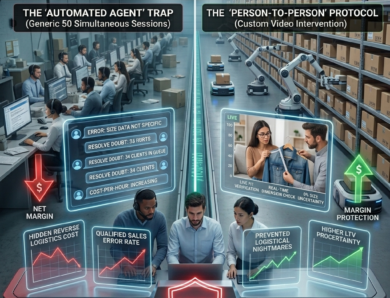
- Alternative CX: If the customer doesn’t know how to use it, the reverse logistics budget is reinvested into Premium Technical Support (video guides or expert chat). It is cheaper to educate a customer than to move a package twice.
Catalog Engineering Strategies: Analyzing Product Net Margins Against Customer Sentiment and Reviews
Your catalog is your first line of defense. It is not designed by popularity; it is designed by return resistance. If a product generates sales but destroys net margin, it is a “Trojan Horse” in your inventory.
1. The Margin-to-Return Ratio (MT-Ratio)
Audit every SKU under this premise: a product with a 20% margin and a 15% return rate is toxic.
- Action: Increase the price to absorb the risk or remove the SKU if description optimization does not reduce the return rate within 30 days.
2. Sentiment Data as Engineering Feedback
Customer reviews are engineering data units.
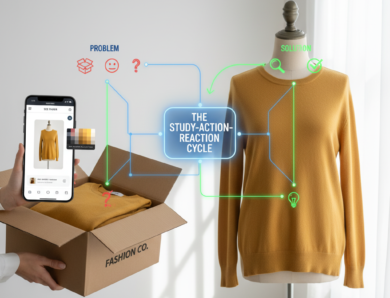
- Pattern Detection: If 5% of reviews mention a product “is darker than in the photo” or “runs small,” the error is in your product page data.
- Proactive Correction: Update the checkout Guardrails specifically for that SKU before the next wave of returns impacts your EBITDA.
3. Algorithm Reweighting (Profit-First Search)
Configure your internal search engine and recommendations to prioritize products with the highest Retained Net Margin, not the “Best Sellers” with high incident rates. In 2026, visibility is a reward for the product’s operational efficiency.
Strategic FAQs: Solving the Balance Between Customer Experience and Operational Profitability
To dominate search intent in 2026, we answer real market frictions with financial engineering and micro-data solutions.
FAQ 1: Is it legally enforceable to charge a “Return Fee” if a customer simply changes their mind? Yes. In 2026, as long as the fee is clearly displayed and the customer performs an affirmative action (checking a mandatory box) at checkout, you can deduct operational processing costs from the refund. This protects your net margin against non-defective returns.
FAQ 2: How can I manage negative customer sentiment regarding a strict return policy? Use Data Transparency. Explain that your prices remain competitive because you do not pass the cost of irresponsible returns onto honest customers. High-quality buyers value this integrity. In 2026, a strict policy is a signal of a premium, operationally sound brand.
FAQ 3: Should I remove best-selling products from my catalog if they have a high return rate? Absolutely. High-volume, high-return products are “Vanity Traps.” They inflate your revenue figures while silently depleting your cash flow. If catalog engineering (improving descriptions or photos) cannot fix the defect, removing the SKU is the only way to safeguard your long-term EBITDA.
FAQ 4: How does micro-data analysis of customer reviews prevent future operational losses? By identifying patterns before they scale. If reviews point to a recurring technical flaw or a size discrepancy, pausing the sale allows you to fix the issue or update the checkout warnings immediately. This prevents upcoming logistics expenses and protects your marketing pixel from “bad sale” data.
Strategic Note: The Evolution of the Static Catalog
Implementing this level of control is not about systematic elimination; it is about intelligent replacement. An e-commerce business in 2026 is not a static entity; it is a system in constant optimization.
When return data points to a massive problem, it opens an engineering opportunity:
- Model Substitution: Replace flawed designs with improved versions that maintain demand but eliminate friction.
- Supplier Migration: Shift to manufacturers that meet your bunker’s quality standards.
- In-House Manufacturing: Sometimes, the only way to guarantee net margin and real satisfaction is to take total control of production.
The goal is movement: Detect the failure to pivot toward a more robust, profitable, and return-proof inventory. There is always an operational way out; stagnation is the only real risk.