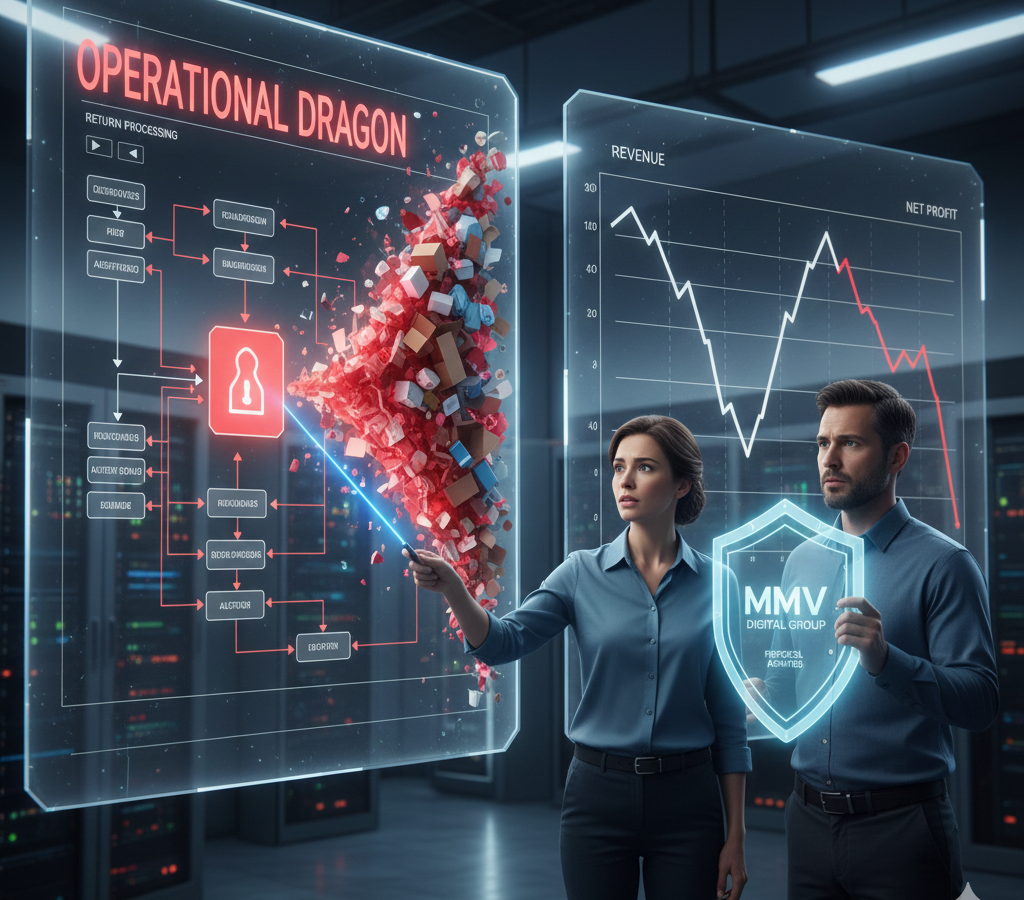
How to reduce ecommerce return rates in 2026 while scaling: The Operational Protocol
The eCommerce landscape in 2026 has reached a tipping point. For years, the industry mantra was “growth at all costs,” but as we move deeper into this decade, that philosophy is proving fatal for mid-market brands. Today, the most significant threat to a scaling online business isn’t the cost of customer acquisition (CAC)—it’s the uncontrolled surge of reverse logistics.
When a store scales from $50k to $150k in monthly revenue, the complexity of its returns doesn’t just double; it mutates. Most retailers are currently operating with 2019 mentalities in a 2026 economy, relying on outdated advice from platforms that prioritize volume over profitability.
The Return Rate Benchmarks: Why your competitors are failing
Current market data for 2026 shows that while average return rates in apparel and electronics hover around 20-30%, the net impact on EBITDA has tripled. This is due to the rising costs of “Backroom Labor”—the specialized man-hours required to inspect, grade, and reintegrate inventory.
While giants like Amazon can absorb these inefficiencies through sheer infrastructure, the independent retailer scaling on Shopify or Magento cannot. We are seeing a massive “Profit Gap” where revenue climbs, but the cost of processing returns is growing at 1.5x the rate of sales. This is the Scaling Trap: becoming a larger company with a smaller bottom line.
Engineering vs. Marketing: The ParcelLab Fallacy
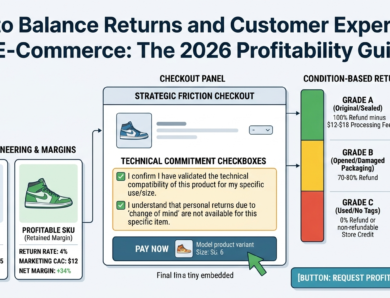
Most high-ranking resources, including the much-cited ParcelLab studies, focus on “Customer Experience” (CX) as the primary lever to reduce returns. They suggest high-quality videos, AR mirrors, and clearer descriptions. While these are necessary for baseline conversion, they are passive marketing tactics, not active operational shields.
To truly reduce ecommerce return rates in 2026 while scaling, you must move the conversation from the Marketing Department to the Operations Department. You don’t need “better photos”; you need a Dynamic Inventory Shield.
1. The “Return-to-Contribution” Audit
Stop measuring returns as a percentage of sales. In a high-scale environment, you must measure the “Margin Leakage per SKU.”
- The Reality: Most stores have “Toxic SKUs”—products that have a high conversion rate but a return rate that destroys the net margin of the entire category.
- The Protocol: Use behavioral data to identify the “Return Velocity” of your inventory. If a product requires more than 10 minutes of manual inspection upon return, its operational cost is likely higher than its profit. These SKUs should be flagged for “Selective Exclusion” in your scaling campaigns.
2. Behavioral Pre-Purchase Intelligence
In 2026, we have the data to predict a return before the transaction is completed. High-performing stores are no longer treating all traffic as equal.
- Geographical Friction: Certain regions or logistics hubs are notorious for higher return rates due to local carrier friction or consumer habits.
- User Profiling: Identifying “Serial Returners” and adjusting their checkout experience—limiting free shipping or offering store credit incentives instead of cash refunds—is the only way to protect cash flow during a massive scale-up.
3. Tiered Reverse Logistics
Scaling brands must abandon the “One Size Fits All” return policy. A $200 high-margin item and a $40 low-margin accessory cannot follow the same logistical path.
- The Solution: Implement a tiered system where low-margin, high-friction items are liquidated or “kept by the customer” to avoid the catastrophic cost of shipping and processing. This isn’t about being generous; it’s about mathematical preservation of margin.
DIRECTOR’S NOTE: The Margin First Mandate
At MMV Digital Group, we observe the market through a cold, technical lens. The “Return Crisis” of 2026 is actually an opportunity for those who prioritize operational engineering over marketing fluff.
If you are currently scaling and your “Top Line” is beautiful but your “Bottom Line” is under siege, you are likely suffering from Operational Drift. Your systems were built for a $10k/month store, but your volume is demanding $100k/month precision.
We don’t sell “tips.” We implement protocols. If you’ve reached the point where scaling feels like a trap, it’s time to calibrate your shield.
EXCLUSIVE ACCESS: OPERATIONAL ENGINEERING BLOCK 1
We don’t want you to invest in a full $3,000 system without first seeing the cash return to your balance sheet. We want the results to fund your transformation.
For this reason, exclusively through this article, we are granting independent access to Block 1.
- Investment: $497 USD.
- Purpose: Immediate tactical implementation on one critical SKU.
- Effect: A reusable asset designed to be 100% effective from week one.
The protocol is simple:
- Acquire Block 1.
- Implement it on a single product in your catalog.
- Visualize the results.
Once you verify the effectiveness of this first maneuver and see the clear improvements, you will be ready to scale the system to the rest of your operations. This is a zero-risk upgrade: let the margin we rescue today pay for your operational excellence tomorrow.
Our Engineering Guarantee: This protocol comes with a total refund policy. If it doesn’t meet our efficiency standards, we will return your investment. It does not matter when you purchased the product; if it doesn’t work for you, we don’t want your money.